
Sweep the ground. Hold the line. Watch a world grow up behind you.
An infinite Minesweeper where the Creep crawls back over every edge you leave open, and settlers make a home on the ground you hold. Free on iPhone, iPad and Android, with no ads.


The board is real Minesweeper
Every number is an honest clue. Tap to reveal, long-press to flag, tap a satisfied number to clear the cells around it. Every world opens on the same 15 by 15 home square, ringed by a fort of mines you can flag by deduction alone. Past the fort, the board doesn’t end.
A mine you hit leaves a crater and bursts the 9 by 9 around it back to covered ground, flags and all. Your streak is your score.
Green numbers hold the Creep back
What you open doesn’t stay yours for free. Every three minutes on Medium the Tide comes, and the Creep takes one layer from every edge you left unsealed. A number with all its mines flagged turns green, and a green number is a wall the Creep can’t cross. Just before each Tide, the edges it is about to take shimmer amber, so you can see where you’re about to lose ground.
Creep left alone darkens through five levels. It sends out monsters, giant rats from young Creep and far worse from old, and it wakes Nests: named knots of Creep that erupt over their ring until you reveal every safe cell in it.

People move in behind your wall
Hold enough ground and settlers arrive. You never give them orders. They build a hall, houses and farms, and they dig up the mines you flagged to give themselves room to grow. Digging is a skill. A settler’s first digs sometimes set the mine off; a few digs later they never do.
Each settler has a name, a family, a trade and a nature. They marry, have children, adopt orphans, make friends and rivals, and grow old. Long-press one to open their card: what they’re doing and the reasons behind it, their household, the things they remember. Tap a village’s card twice to see its people by name, household by household, and its history.

You help them one way: by sweeping. There is one exception. Tap a villager and a small heart floats up. For a while they’re a little happier and a little luckier, and that’s all it does.


A year in an hour
A day is five minutes and a year is an hour of play. Fields are planted in spring and harvested in autumn, and one year in six the harvest is poor. Winter runs on stores and firewood. Each people keeps four festivals a year under its own names: the Humans’ Midsummer Fair falls on the same day as the Elves’ Long Light and the Orcs’ Trial of Strength.
The economy runs on real goods. Wood, stone and the ore that comes out of dug mines go to carpenters, smiths, weavers, tanners, millers and bakers. Carters lead donkeys between them, and every second evening is a market.

Five peoples, each with its own ways
Humans farm the plains and trade the most. Elves live in the ancient forest and fell no living tree: they gather windfall and plant groves, and they think less of a village that cuts trees near them. Orcs hold the badlands, stand longer in a fight and honour the ones who kill monsters. Dwarves in the mountains dig quicker, get more ore and hoard metal. Desert Humans dig wells to water their farms and send out a few long camel caravans.
They keep to themselves and trade in goods only the other people has. Every pair of villages has a regard that trade raises and slights lower. Elves and Orcs start out wary of each other.
 Humans
 Elves
 Orcs
 Dwarves
 Desert Humans


Only the Creep kills
Hunger, cold and poverty make people unhappy and sometimes make them leave. They never kill anyone. Elders die of old age. The Creep and its monsters are the only danger.
Old Creep next to a village fills its people with dread, and you watch it rise on the village’s card long before anyone runs: households flee only after a quarter of an hour of it. Sweep the Creep back and the ones who fled walk home. Keep up with the Creep and your settlers win their fights.


A few villages you know by name
Before launch, a tester played one world for 24 hours on a Pixel 8. It grew 47 villages and 1,322 people, and it lagged. Worse, you can’t root for one village out of 47. Now a long world keeps at most eight villages, one per people in each region, and they grow deeper instead of more numerous. A village tops out at 40 people and a town at 60, with named quarters, roads to its neighbours, heroes, heirlooms and monuments to the Nests its people watched you kill.

Peaceful mode
The whole game is free. The one purchase is Peaceful mode, $1.99 once. It freezes the Creep: no Tide, no new monsters, and the Creep already on the board stays where it is until you clear it. Switch it on or off in any world, at any time, and the clock picks up exactly where it stopped. If you get a new phone, Restore purchases in Settings brings it back.
Dawnsweeper
Free no ads
The endless board, the Creep and Nests, all five peoples, towns and festivals, several worlds.
Peaceful mode
$1.99 once
The Creep frozen, in any world, on or off at any time.
From the blog
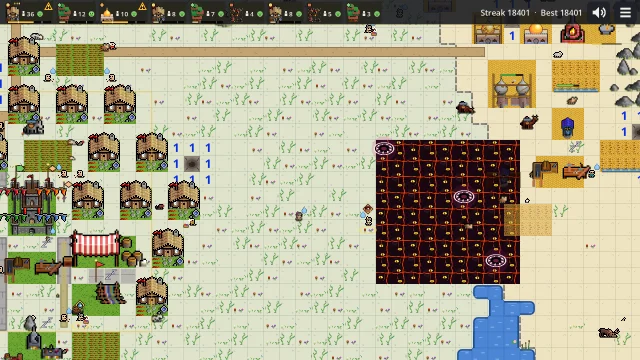
In Dawnsweeper, only the Creep kills
Hunger, cold and poverty in Dawnsweeper bring hardship and people leaving, never death. What one hour of a big world looks like under that rule.
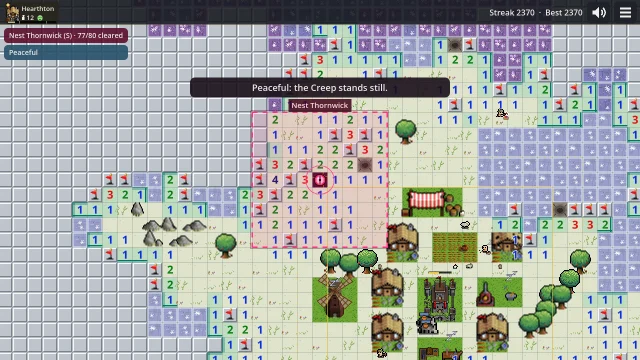
Peaceful mode freezes the Creep instead of deleting it
Dawnsweeper’s one purchase is Peaceful mode. Why it stops the Creep’s clock in place, and how a Tide due in 20 seconds is still due in 20 seconds later.
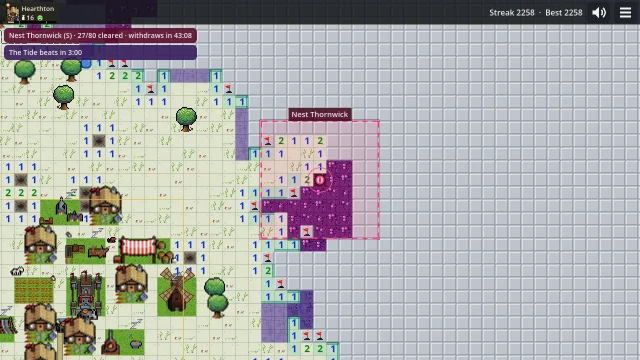
The Nest that said 440/440 and wouldn’t die
A Dawnsweeper Nest showed its whole ring cleared and kept pulsing. The cause was one wrong flag, and the fix had to avoid telling you which.
Credits
Dawnsweeper is made by Uthentic, Inc.
Pixel art: Minifantasy by Krishna Palacio. Music and sound effects: Leohpaz. Ambience: Ovani Sound. Board numbers in Noto Sans. Made with the Godot Engine.
No generative AI was used in the art or the sound.